martes, 13 de diciembre de 2016

Diphthongs


Vowels are determined by changes in position of the lips, tongue and palate. These changes can be very slight and difficult to detect. In English, vowels can also glide into one another to form diphtongs and even tripthongs.

Diphthongs are those sounds that consist of a movement or glide from one vowel to another. The firts part of a diphthong is always longer and stronger than the second part. 

/ei/

Spelling: the sound /ei/ is usually written with the letters: 

            1. A: baby, face, late, page, place, same, take (the final "e" indicates that " a" is pronounced                     /ei/. without this final "e" the pronunciation would be a voquel. 
            2. Ay: day, say, stay, today, way
            3. Ai: rain, Spain, train, wait. 
            4. Ea: great, weight, steak
            5. Other

Transcribe the following words:

- Paper [ˈpeɪpə ] 
- Sail [seɪl ]
- Radio [ˈreɪdɪəʊ ]
- James [ʤeɪmz ]
- Railway [ˈreɪlweɪ ]
- Station [ˈsteɪʃən ]
- Newspaper [ˈnjuːspeɪpə ]
- Date [deɪt]
/ou/ /eu/ /əʊ/

This has two sounds /ə/ and /ʊ/. The second element of the diphthong is very short and the first one is longer than /e/. The lips at the beginning are in a neutral position and the dragudally rounded as the tongue rises to make /u/.

Spelling: The sound /əʊ/ is usually writen witht the letters:

           1. o: go, hello, no, old, only, hotel.
           2. o...e: home, hole, nose, those.
           3. oa: boat, coat, road, Joan.
           4. ow: know, low, narrow, show, slow, throw.
           5. ou: though, soul, shoulder
           6. Some words: boat, Joan, Jone's, hoel, hello.

/ai/

This has two sounds /a:/ and the add /i/ this is a short sound. Most students have no difficulties with this sound.

Spelling: the sound /ai/ is usually written with the letters "i" or "y".

  • i, y: child, find, five, smile, try, by, fly, right, sky,..
  • igh: high, light, night, right, bright.
  • ye; eye, goodbye.
  • Other spellings: lie, buy
Pie [ Pai ]
Kite [ Kait ]
Climbing [ Klaimin ]
Riding [ Raidin]
Rice [ Rais ]
Bright [ Brait ]
Ice-cream [ Ais-kri:m ]
Ice-skating [ Ais-skeitin ]
Goodnight [ gʊdnait ]
Friday [ Fraidei ]

/au/

The first sound is, in some way, similat to /ae, the add /uu/; this second sound is very short. There is an /au/ diphthong in Spanish bit it is 

Spelling: the sound /au / is written with the letters:
  • ou: about, mouth, count, round, out.
  • ow: cow, crowd, flower, down, now, town, brown. 
Flowers [Flauəz]
Mouse [Mauz]
Mice [Maiz]
Thousand  [θaʊznd
Cows [Cauz]
Trousers [Trauzəz]

/oi/

The two sounds in this diphthong are: /o:/ even pronounced longer, then /i/, being even shorter. There are few words for practice of this sound at beginner level. 

Spelling: the sound /oi/ is written with the letters:
  • oi: noise, point, voice,...
  • oy: boy, toy, employ,...

CENTRIC DIPHTHONGS

/iə/

In this diphthong both elements are short, but the accent falls on the first one. When this diphthong is 
followed by an "r", this consonant is not pronounced except when  the following syllable or word begins
with a vowuel, in this case a lingling "r" can be pronounced.

Spelling: 
  • ea: dear, hear, ear, near.
  • er: deer, beer, here
  • other spellings: idea, real, museum. 
/eə/

The first sound is an /e/ but you have to make it a little longer, then add /ə/, Most students produce the -er 
ending with the "r" always pronounced. 

Spelling
  • are: share, scare, mare, care 
  • air: chair, pair, air, 
  • ear: bear, tear
  • Other spellings: their, they're
Beer [ biə ]
Near [ niə ]
Here [ hiə ]
Chair [ ʧeə  ]
Where [ weə  ]
Airtport [ ˈeəpɔːt  ]
Square [ skweə  ]

/oə/

The diphthong /oə/ is normally replaced by a /ɔː/ by RP speakers, that is why I don't think it is important
although we don't care about it's production you should understand it. 

Spelling:
  •    oar, ore, our, oor: boar, for, soar, your, pour. 
/uə/

The first element is a /u/ and the sectond one is a /ə/. It is often pronounced /ɔː/ or /ɔ/

Look  at the following examples:
  • Poor: [puə][poə][pɔː]
  • Sure: [ʃuə] [ ʃoə][ ʃɔː]
Spelling:
  • -or, ure, oor: tour, pure


jueves, 1 de diciembre de 2016

/ə/

The schwa is an unstressed centra vowel and is the most common vowel to appear in English. There is no similar sound in Spanish. We tend to assimilate is to an unstressed "e" when it is not final

Most important spelling

It has no regular character to represent it. Any voquel or group of vowels may in unstressed position may respresent /ə/.

Minimal Pairs.

As it never occurs in stressed position, there are no contrastive elements. 

/ə:/ -/3:/

Approximate Castilian Production:

There is no similar sound in Spanish. This is a central  vowel. The lips are not rounded.

More important spellings

  • ir: first
  • er: serve
  • ear; earth
  • ur
  • or
  • our

/ə:/
/e/
Bird
Bed
Learned
Lend
Turn
Ten
Burn
Ben
World
Wed

/ʌ/

Approximate Castilian Production:

This phoneme that, together with /a:/ and /ae/ is a focus of confusion for Spanish speakers who can assimilate it to an "a" sound. This sound sems to be moter approximate to the Spanish "A" whe it is accompanied by velar consonants: regate, coja, jaque.

Most important spellings:
  • u: sun, ran, fun
  • o: won, come, done
  • ou: country, southern, young
  • oo: blood, flood. 

Minimal pairs 

/
/ae/
Cup
Cap
But
Bat
Run
Ran
Some
Sam
Uncle
Ankle
Much
Match
/
/e/
Money
Many
But
Bet
Won
When
done
den

martes, 29 de noviembre de 2016

/u:/

Most important spellings:


  • oo: spoon, shoot, troop, boom
  • ou: soup, route
  • o: do
  • u: June, flu

/u:/
/ʊ/
Fool
Full
Luke
Look
Cooed
Could
Shoed
should
Pool
Pull

/ʊ/

Approximate Castilian production: The Spanish sound is produced at the back and it is tenser. A similar sound can be heard when it is next to "r" and "l": hurto, pulso...

Articulation: the tongue and jaw are raised as the back of the tongue is used to articulate this vowel. Hence it is a back, close (high) voquel. The lios are rounded. 

Most important spellings

  • u: full put
  • oo: book, look
  • ou: could, should
  • o: woman 

/ɔ:/

Most important spellings

  • o: horse
  • oor: poor
  • ore: more
  • aw: saw, law
  • oar: board
  • ou: bought
  • our: four
  • a: all
  • au: taught
Minimal pairs


/ɒ/
/ɔ:/
Cot
Caugth
Spot
Sport
Shot
Short
stock
stalk

/ɒ/

The organs of articulation maintain similar position to the ones of /a:/. The rongue and jaw are lowered as the back of the tongue is used to articulate this vowel. The lips are slightly rounded (portal, cortar, cordial, loro).

Most important spelling that represent /o/

  • o: not, box, dog. 
  • a: want, what, watch
Minimal pairs


/a:/

-Approximate Castillian Production: It does not exist in Spanish. This sound and /ae/ and /^/ are a focus of confusion for begginers. Some Spanish people pronounce /g/ as a guttural instead of velar, specially between vowels, this /a/ is similar to English corresponding. e.g. Haga, traga, saga.

The importat aspect is to give double quiantity, because it's a long vowel.


-Most important spelling that represent /a:/:

 1. a: ask, grass, car
 2. er, ear: clerk, heart
 3. al: half, calm
 4. au: aunt, laungh

Minimal Pairs


jueves, 24 de noviembre de 2016

/æ/

-Approximate Castillian Production: in Castillian there is not a similar vowel, on the other hand it is in the speech of many Valencians. The most approximate sounds would be in syllables that had a palatal consonant. e.g. chanza, ancha, llano, fallo.

(at: /æt/)

-Most important spelling that represent /æ/:

 1. "a": hand, match, lamp

Minimal Pairs


martes, 22 de noviembre de 2016

/e/

Production:

-Approximate castillian production: The Castillia /e/ is usually more closed and tenser than the English equivalent. Nevertheless you can get a more opern realization in the following cases.
                  
The most important speellings

       1. Ea: Head, dead
       2. E: bed
       3. A: many


/I/

- Production: When you say this vowel sound, the front of the tongue is raised towards the palate. In fact, the position of the whole tongue is relatively high in the mouth, making it a closed vowel. The lips are slightly spread.

-Approximate castillian production: in the first stages of learning English, Spanish-speakers usually have difficulties in distinguishing /i/ and /i:/, since both are varieties but don't make any difference in meaning. We can find an approximate production when the Castilian /i/ is unstressed position. (último, cursi, pitar)

The Castillian vowel us more closed and tenser nevertheless, as the English /I/ is more relaxed and lightly more centralized, some perceive it as /e/ especially in milk, fill, pin.

The most important speellings

    1. Mainly: "i" and "y"
         - Rich, lady, body, milk,...
         - In unstressed position it may be represented by any vowel: Language [ laen.gwid3]; Wanted                 [wan:ntid].
         - Money ['m^n.i]
         - Minute ['min.it]

Minimal Pairs


/i:/

- Production: Being a long vowel, it almost sound like a diphtong in RP. It is long enough to be one, but it does not actually glide into another vowel sound. The lips are only slightly spread.

-Approximate Castillian Production: It is found in the tonic Castilian /i/ accompanied by dental or palatal consonants. (Capilla, castillo, sí, chino)

Most important spellings that represent /i:/

      1. ee: see, feed, bee.
      2. ea: read, eat
      3. ie: shield, field
      4. e: scene [si:n], be, these


jueves, 17 de noviembre de 2016

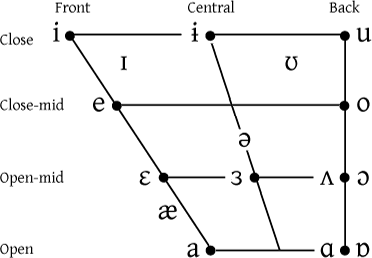
Vowels

Most sonorant (audible) sounds, which is caused by vocal fold vibrationl. Its usual function as syllable.

- Tongue height: high/mid/low
- Tongue backness: front/central/back
- Lip rounding: round/ unround
- Tenseness: tense/lax

Tongue Height

Put your hand under youu chin and say seat, set, sat.

High: leak, lick, luke, look
        - [í:][I][u:][u]
Mis: bait, bet, but, bought, boat
        - [eI][e][^][]
Low: cat, car
         -[][a:]

Tongue Advancement

Front: seek, sick, sake, sec sack
         - [i:] [I] [ei] [e] [ae]

Central: luck
          - [^]
Back: look, road, law, dot
          - [u] [] [] []

Tenseness

- Tense vowels: the tongue is at an extreme height or backness.
- Lax vowels
            The tongue is not an extreme position.
                  Compare Pete and pit.

Voiced/ Voiceless


Resultado de imagen de voiced/voiceless
The level of vibration of the vocal cords determines wheter a sound is voiced or unvoicd. If the vocal cords are apart, the air can escape unimpeded. Sounds produced in this way are said to be voiceless. If the vocal cords are very close together, the air will blow them apart as it forces its way through. This makes the cords vibrate, producing a voiced sound

martes, 15 de noviembre de 2016

Phonetics

What is Phonetic?

Phonetics is the study of speech: how speech is produced and how it is perceived and it differs from phonology. The subject matter of phonology  is the investigation of sound systems by mean of observation.

ICT for 

Thanks to the ICT you can listen to authentic English on the radio stations, TV, music, and so on. Moreover you can use dictionaries, either on-line or off-line, or word processors together with sound. Make of use of your own recordings.

The Organs of Speech

Resultado de imagen de organs of speech

Vowels in English

Resultado de imagen de english vowels